

How To Draw A Spiral Galaxy
Hither's a recent question from reader Pehr in Sweden:
Hullo,
First of all, wonderful site. Love it.
I've been studying the polar coordinates section hoping to expand my knowledge on the equiangular screw. The interactive tools are slap-up, though I'm having a hard time to derivate the exact mathematical solution to why the resulting function for the golden screw is
r = ae^(b(theta))
For some background on Pehr'south question, run across:
Polar Coordinates, Curves in Polar Coordinates and Equi-athwart Spiral
Spirals are mutual in nature and have inspired mathematicians for centuries.

Spiral galaxy NGC 5194
[Image courtesy NASA]
Logarithmic Spirals
The Golden Screw that Pehr is asking about is a special example of the logarithmic screw.
Logarithmic spirals grow such that the angle of a line from the eye of the spiral to the tangent to the curve at that point is constant. This is why they are as well known as "equi-athwart" spirals.
To come across what this means, the 3 acute angles marked in the post-obit fern epitome are approximately 80°
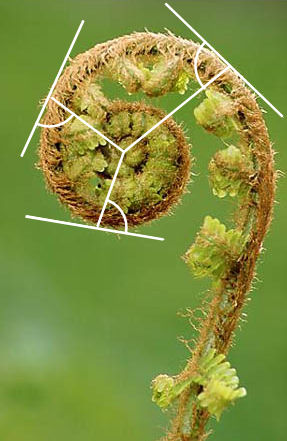
Equi-angular fern
We normally use functions in Polar Coordinates when describing spirals. Otherwise, if we employ ordinary rectangular coordinates, the formulas become very complex.
The formula for a logarithmic spiral using polar coordinates is:
r = ae θ cot b
where
r is the distance from the origin (or "pole")
a is a constant
θ is the angle (in radians) from the horizontal axis. So the coordinates of a point on the curve in polar coordinates is given by (r, θ).
b is the angle (in radians - the "equal" bending) that the line from the center of the spiral makes with the tangent to the spiral. In the fern case above, b ≈ 1.4 radians (≈ 80°).
As a result of the way we defined the logarithmic spiral, the ratio of the distances from the heart to each spiral arm of an adjacent pair is constant.
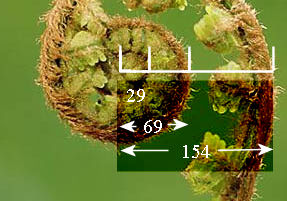
Spiral artillery at a constant ratio
The ratio
distance to the first arm: distance to second arm
= 29:69
≈ 0.42
The other ratio
distance to the second arm: altitude to third arm
= 69:154
≈ 0.45
Nosotros see the ratios are almost the same. (In an actual logarithmic spiral, they are exactly the same. Choosing the start point for the fern is not an exact science!)
Gilded Spiral
The Aureate Spiral is a special case of the logarithmic spiral.
We can write the general logarithmic screw every bit a role in polar coordinates using t equally follows:
r(t) = ae t cot b
Note: Usually, nosotros utilise θ for the contained variable, but we oftentimes use t as we can recall of the screw beingness traced out over fourth dimension. Also, information technology'southward easier to type!
The Golden Spiral has the special holding such that for every 1/4 turn (90° or π/2 in radians), the distance from the center of the spiral increases by the golden ratio φ = one.6180.
For this to occur, cot b must take the value (which comes from solving our function):

Using this value, and taking the simple instance where a = 1, our function becomes:
r(t) = e 0.30635t
We'll use the excellent complimentary graphing tool GeoGebra from here on.
Setting up the Golden Spiral using GeoGebra
Now if we graph our function on ordinary rectangular coordinate axes in GeoGebra, nosotros become the following exponential curve. Annotation that r increases at an ever-increasing charge per unit (it gets steeper) as t increases.
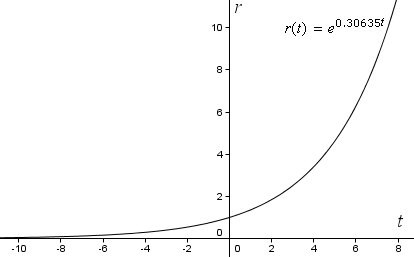
But to see a spiral, we need to graph the curve using polar coordinates.
To convert the polar form (which nosotros've got) to rectangular grade (which we need for the graph) in Geogebra, we need to set up and graph the following function:
a(t) = (r(t) cos(t), r(t) sin(t))
Let'southward substitute a few important values to come across what this expression means. Starting at t = 0, we get the starting point of the curve:
a(0) = (r(0) cos(0), r(0) sin(0))
= (one×1, 1×0)
= (1, 0)
So it ways we get-go 1 unit from the origin along the positive x-axis. You can see the starting point in the following graph of the screw.
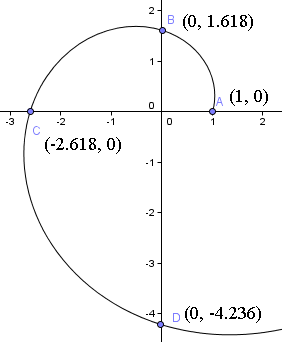
Next, we rotate a quarter turn and discover at t = π/two,
a(π/ii) = (r(π/2) cos(π/2), r(π/2) sin(π/two))
= (1.618×0, 1.618×1)
= (0, i.618)
Note that we are now i.618 units from the origin up the y-axis. That is, φ = ane.6180 times the distance nosotros started from.
Another rotation of a quarter plough brings united states to t = π, where:
a(π) = (r(π) cos(π), r(π) sin(π))
= (-2.618×ane, -2.618×0)
= (-2.618, 0)
We are now two.618 units away from the origin along the negative ten-axis, or φ = i.6180 times the distance from the origin nosotros were at the final quarter turn.
Note:
φ2 = 2.6180
Nosotros could piece of work out our next position, along the negative y-axis, by just multiplying this last value by φ = ane.6180, giving us:
φ3 = 4.23606...
So the spiral will cut the y-centrality at (0, -4.236).
One more quarter turn will bring us to φiv = vi.85410... units forth the positive y-axis, that is (vi.854, 0).
We can run across these values are correct on our screw graph to a higher place.
If nosotros go on going, we'll go a spiral as follows (this is two complete revolutions, or 4π = 720°):
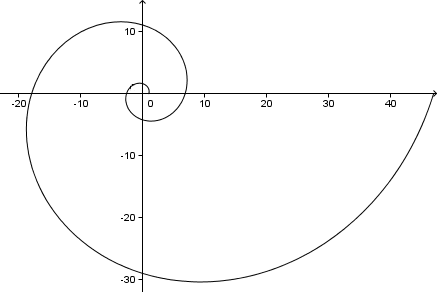
As an bated, since in this problem
cot b = 0.30635
then
b = arccot 0.30635 = 1.274 radians or effectually 73°
This is the bending our spiral arms brand with a line from the centre of the spiral. You can encounter on the graph in a higher place each screw arm makes an bending of 73° with the x-axis (and y-axis, or any line from the center).
Approximating the Golden Spiral using arcs of a circumvolve
We tin obtain a screw that looks quite similar to the Golden Spiral by using arcs of circles that increment in size past the Golden Ratio, as follows.
We start with a one×1 square and draw an arc, center C, through 2 corners such that the sides of the foursquare are tangent to the arc (that is, they touch on once simply).
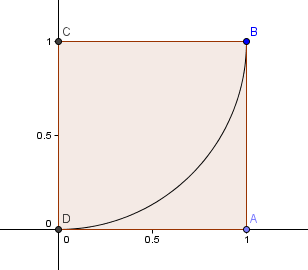
Next, we identify a square with side length φ = 1.6180 above our first foursquare and construct another circular arc, centre Eastward, as before:
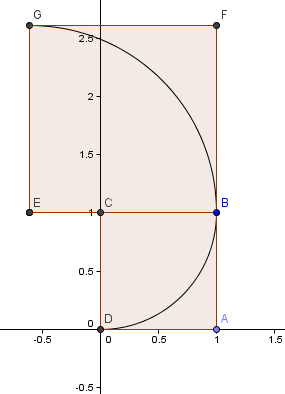
Our adjacent foursquare goes on the left and has sides φtwo = 2.6180 = ane + φ.
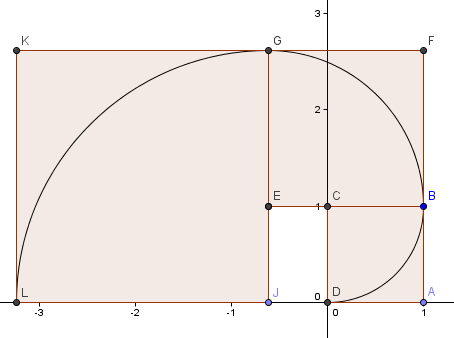
Nosotros continue the pattern (nosotros've gone some other complete round) and get a screw which looks quite a lot similar our Aureate Screw from earlier.
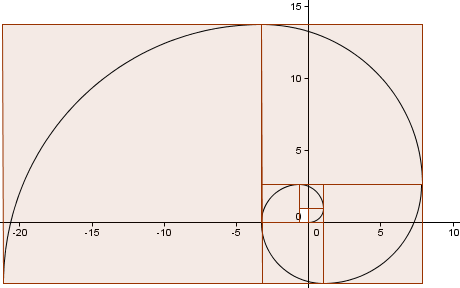
How shut is our approximation?
Wikipedia's article on Golden Spiral has an paradigm which claims the above spiral and the Gilt Spiral are very close in shape.
Here's that image:
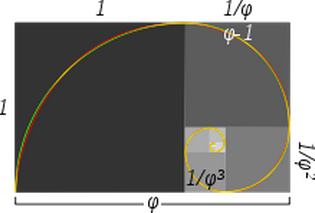
The explanation for the image states:
Approximate and true golden spirals: the green spiral is made from quarter-circles tangent to the interior of each square, while the ruby spiral is a aureate screw, a special type of logarithmic spiral. Overlapping portions appear yellow. The length of the side of a larger square to the next smaller square is in the golden ratio.
Can nosotros re-create this ?
In the paradigm below, the cherry curve is first part of the Golden Spiral we constructed above, whereas the green bend is based on the quarter-plow approximation we were just working on.
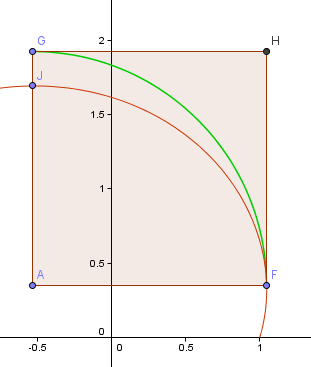
The indicate F is the "right most" betoken on the spiral, which will be my starting point for the quarter-turn arc. The point J is the highest point of this portion of the spiral.
Point A is the intersection of the horizontal and vertical lines passing through F and J respectively and this will exist the center of my arc.
Now, the arc GF is not at all close to the related portion of the spiral FJ.
Let's do another step and see if the next part is any improve.
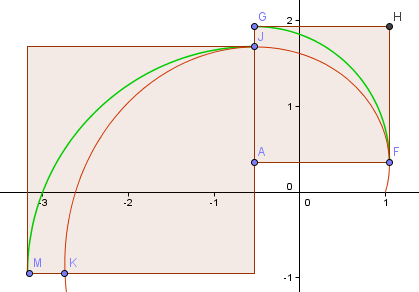
Equally you can see, it's worse (every bit expected, since we take moved further away from the origin and the spiral arm is getting bigger).
Clearly, this is never going to piece of work.
However, in my earlier Golden Spiral I was using:
r(t) = e 0.30635t
The abiding a, had value one.
If nosotros want our approximating arcs to exist a good fit for the bodily Golden Spiral, we demand to apply a value of (probably non surprisingly)
a = φ = 1.618103399..
This gives the states the post-obit curves, similar to the graph in Wikipedia.
The cherry curve is the Gilt Spiral,
r(t) = 1.618013 east 0.30635t
The green curve is the collection of circular arcs.
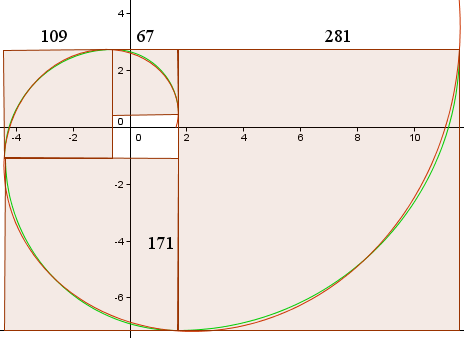
The side length of the squares (in pixels) are shown and we tin can see they are approximately in the ratio one.618013...
Golden Spiral in the media
From Wolfram'due south Mathworld:
In the Flavor 4 episode "Masterpiece" (2008) of the CBS-TV crime drama "Criminal Minds," the agents of the FBI Behavioral Assay Unit are confronted by a serial killer who uses the Fibonacci number sequence to make up one's mind the number of victims for each of his killing episodes. In this episode, character Dr. Reid as well notices that locations of the killings lie on the graph of a gilded spiral, and going to the center of the spiral allows Reid to determine the location of the killer's base of operations of operations.
Here's more interesting information from Wolfram'due south Mathworld:
Logarithmic Screw
For the geeks - pattern using Golden Spiral
It is believed by many that designs using the Golden Ratio and Gold Screw are pleasing to the eye.
Fifty-fifty Twitter recently re-designed their main page using the Golden Spiral.
Here is a great article by a guy who has contructed a aureate spiral without images. (Mostly for those interested in Web blueprint)
Golden Spiral without images - using CSS and jQuery
As he suggests in the article, an elephant'southward trunk is also close to the Gilt Screw.
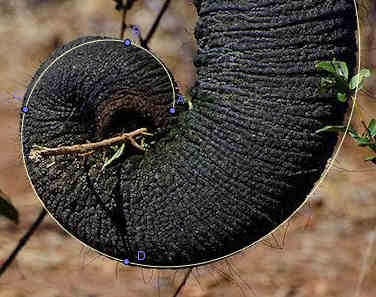
Elephant trunk - almost a Golden Spiral
Conclusion
The Gold Spiral is an interesting topic - one worth pursuing not merely for the pleasant designs involved, just also the interesting math behind them.
I promise that helps to reply your question, Pehr!
See the 21 Comments beneath.

Source: https://www.intmath.com/blog/mathematics/golden-spiral-6512
Posted by: perezthavall.blogspot.com
0 Response to "How To Draw A Spiral Galaxy"
Post a Comment