

What Percentage Of Makeup Is Tested On Animals
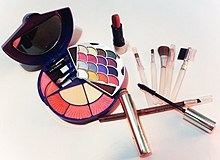
Assorted cosmetics and tools
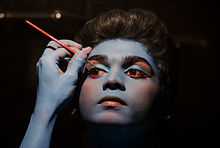
An actor applying assuming makeup for a stage functioning

Actor Marcus Stewart wearing bold face makeup in the play Oresteia by Aeschylus (2019)
Cosmetics are constituted mixtures of chemical compounds derived from either natural sources, or synthetically created ones.[i] Cosmetics have various purposes. Those designed for personal care and peel care tin can be used to cleanse or protect the body or skin. Cosmetics designed to enhance or modify i's appearance (makeup) can be used to conceal blemishes, enhance i's natural features (such as the eyebrows and eyelashes), add color to a person's face, or change the appearance of the confront entirely to resemble a dissimilar person, creature or object. Cosmetics can as well exist designed to add fragrance to the torso.
Definition and etymology [edit]

The word cosmetics derives from the Greek κοσμητικὴ τέχνη ( "kosmetikē tekhnē" ), pregnant "technique of dress and decoration", from κοσμητικός ( "kosmētikos" ), "skilled in ordering or arranging"[2] and that from κόσμος ( "kosmos" ), significant "order" and "ornament".[3] Cosmetics are constituted from a mixture of chemic compounds derived from either natural sources, or synthetically created ones.[1]
Legal definition [edit]
Though the legal definition of cosmetics in most countries is broader, in some Western countries, cosmetics are commonly taken to mean only makeup products, such as lipstick, mascara, heart shadow, foundation, blush, highlighter, bronzer, and several other product types.
In the U.s.a., the Food and Drug Administration (FDA), which regulates cosmetics,[4] defines cosmetics as products "intended to be applied to the human being body for cleansing, beautifying, promoting attractiveness, or altering the appearance without affecting the body's structure or functions". This wide definition includes any material intended for employ equally an ingredient of a cosmetic product, with the FDA specifically excluding pure soap from this category.[five]
Utilize [edit]
Cosmetics designed for skin intendance can be used to cleanse, exfoliate and protect the pare, as well as replenishing it, through the use of cleansers, toners, serums, moisturizers, and balms. Cosmetics designed for more full general personal care, such every bit shampoo and torso launder, can be used to cleanse the body.
Cosmetics designed to heighten one's advent (makeup) can be used to conceal blemishes, enhance ane's natural features (such as the eyebrows and eyelashes), add together color to a person'south face and—in the case of more than farthermost forms of makeup used for performances, style shows and people in costume—can exist used to alter the advent of the face entirely to resemble a different person, creature or object. Techniques for irresolute appearance include contouring, which aims to give shape to an area of the face.
Cosmetics can also be designed to add fragrance to the body.
History [edit]
Cosmetics have been in use for thousands of years, with aboriginal Egyptians and Sumerians using them. In Europe, use of cosmetics continued into the Middle Ages—where the face was whitened and the cheeks rouged—[half-dozen] though attitudes towards cosmetics varied throughout time, with the apply of cosmetics being openly frowned upon at many points in Western history.[7] Regardless of the changes in social attitudes towards cosmetics, ethics of appearance were occasionally achieved through the utilise of cosmetics by many.
Co-ordinate to ane source, early on major developments in cosmetics include:[ane]
- Kohl used by aboriginal Egyptians
- Castor oil also used in aboriginal Egypt as a protective balm
- Skin creams fabricated of beeswax, olive oil, and rose water, described by the Romans
- Vaseline and lanolin in the nineteenth century.
Historically, the absence of regulation of the manufacture and use of cosmetics, besides as the absence of scientific knowledge regarding the furnishings of various compounds on the human body for much of this time period, led to a number of negative agin furnishings upon those who used cosmetics, including deformities, incomprehension and in some cases death. Many cosmetic products available at this fourth dimension were however either chemically dubious or derived from natural resources commonly found in the kitchen, such as nutrient colouring, berries and beetroot. Examples of the prevalent usage of harmful cosmetics include the use of ceruse (white atomic number 82) throughout a number of different cultures, such as during the Renaissance in the W, and incomprehension acquired by the mascara Lash Lure during the early 20th century. During the 19th century, there was a loftier number of incidences of lead poisoning due to the mode for red and white atomic number 82 makeup and pulverization, leading to swelling and inflammation of the eyes, weakened molar enamel and blackening skin, with heavy use known to lead to expiry. Usage of white lead was not confined only to the West, with the white Japanese face makeup known every bit oshiroi besides produced using white lead. In the second office of the 19th century, scientific advances in the production of makeup lead to the creation of makeup complimentary of hazardous substances such as atomic number 82.[ citation needed ]
Throughout the subsequently 19th century and early 20th century, changes in the prevailing attitudes towards cosmetics led to the wider expansion of the cosmetics manufacture, with the market place developed in the Us during the 1910s by figures such as Elizabeth Arden, Helena Rubinstein, and Max Factor. These firms were joined by Revlon just before World War Two and Estée Lauder merely subsequently. By the middle of the 20th century, cosmetics were in widespread utilize by women in about all industrial societies around the world, with the cosmetics manufacture condign a multibillion-dollar enterprise by the kickoff of the 21st century.[ commendation needed ] The wider acceptance of the use of cosmetics led some to see makeup as a tool utilised in the oppression and subjection of women to unfair societal standards. In 1968 at the feminist Miss America protestation, protestors symbolically threw a number of feminine products into a "Freedom Trash Tin can",[8] with cosmetics amidst the items the protestors called "instruments of female torture"[9] and accoutrements of what they perceived to be enforced femininity.
As of 2016[update], the earth's largest cosmetics company is L'Oréal, founded past Eugène Schueller in 1909 as the French Harmless Hair Colouring Company (now endemic by Liliane Bettencourt 26% and Nestlé 28%; the remaining 46% is traded publicly).
Although modernistic makeup has been traditionally used mainly past women, an increasing number of men are using makeup to raise their own facial features or cover blemishes and dark circles. Cosmetics brands have increasingly targeted men in the sale of cosmetics, with some products targeted specifically at men.[10] [eleven]
Types [edit]
Though there are a large number of differing cosmetics used for a multifariousness of different purposes, all cosmetics are typically intended to be applied externally. These products can be applied to the face (on the skin, lips, eyebrows and optics), to the body (on the skin, in detail the hands and nails), and to the pilus. These products may be intended for apply every bit skincare, personal intendance or to alter the appearance, with the subset of cosmetics known equally makeup primarily referring to products containing colour pigments intended for the purpose of altering the wearer's appearance; some manufacturers volition distinguish only between "decorative" cosmetics intended to change the advent and "intendance" cosmetics designed for skincare and personal care.
Most cosmetics are as well distinguished by the area of the torso intended for application, with cosmetics designed to be used on the face and center surface area usually applied with a brush, a makeup sponge, or the fingertips. Cosmetics can exist likewise described by the physical limerick of the production. Cosmetics can be liquid or cream emulsions, powders (pressed or loose), dispersions, or anhydrous creams or sticks.


Decorative [edit]
- Primers are used on the face before makeup is applied, creating a typically transparent, shine layer over the elevation of the skin, allowing for makeup to exist applied smoothly and evenly. Some primers may as well exist tinted, and this tint may match the wearer'southward skin tone, or may colour correct information technology, using greens, oranges and purples to even out the wearer'due south pare tone and correct redness, imperial shadows or orange discolouration respectively.
- Concealer is a cream or liquid product used to muffle marks or blemishes of the skin. Concealer is typically the colour of the user's skin tone, and is mostly applied later the face has been primed to even out the wearer'southward skin tone before foundation can be applied. Concealer is usually more heavily pigmented, higher coverage and thicker than foundation or tinted primers. Though concealer is frequently more than heavy duty in terms of pigment and consistency than foundation, a number of different formulations intended for unlike styles of use - such as a lighter concealer for the eyes and a heavier concealer for stage makeup - are bachelor, too as colour correcting concealers intended to balance out discolouration of the skin specifically.
- Foundation is a foam, liquid, mousse or powder product applied to the entirety of the face to create a shine and fifty-fifty base in the user's pare tone. Foundation provides a mostly lower corporeality of coverage than concealer, and is sold in formulations that tin provide sheer, matte, dewy or full coverage to the skin.[iv]
- Rouge, blush, or blusher is a liquid, cream or pulverisation product applied to the center of the cheeks with the intention of adding or enhancing their natural color. Blushers are typically available in shades of pinkish or warm tan and chocolate-brown, and may also be used to brand the cheekbones announced more defined.[4]
- Bronzer is a powder, cream or liquid product that adds color to the skin, typically in bronze or tan shades intended to give the skin a tanned appearance and enhance the colour of the face up. Bronzer, like highlighter, may also contain substances providing a shimmer or glitter consequence,[4] and comes in either matte, semi-matte, satin, or shimmer finishes.
- Highlighter is a liquid, cream or pulverization product applied to the high points of the face up such as the eyebrows, nose and cheekbones. Highlighter commonly has substances added providing a shimmer or glitter effect. Alternatively, a lighter toned foundation or concealer can exist used as a highlighter.
- Eyebrow pencils, creams, waxes, gels, and powders are used to color, fill in, and ascertain the brows.[4] [12] [13] Eyebrow tinting treatments are as well used to dye the eyebrow hairs a darker color, either temporarily or permanently, without staining and colouring the skin underneath the eyebrows.
- Eyeshadow is a powder, cream or liquid pigmented product used to draw attending to, accentuate and change the shape of the surface area around the optics, on the eyelid and the space beneath the eyebrows. Eyeshadow is typically applied using an eyeshadow brush, with by and large small and rounded bristles, though liquid and cream formulations may also be applied with the fingers. Eyeshadow is available in most every colour, equally well equally being sold in a number of unlike finishes, ranging from matte finishes with sheer coverage to glossy, shimmery, glittery and highly pigmented finishes. Many dissimilar colours and finishes of eyeshadow may exist combined in 1 look and blended together to accomplish different furnishings.
- Eyeliner is used to heighten and elongate the apparent size or depth of the eye; though eyeliner is commonly black, it can come in many different colours, including chocolate-brown, white and blue. Eyeliner can come in the form of a pencil, a gel or a liquid.
- False eyelashes are used to extend, exaggerate and add volume to the eyelashes. Consisting generally of a small strip to which hair - either human, mink or constructed - is attached, false eyelashes are typically practical to the lash line using glue, which tin can come in latex and latex free varieties; magnetic false eyelashes, which adhere to the eyelid after magnetic eyeliner is applied, are also available. Designs vary in length and colour, with rhinestones, gems, feathers and lace available as simulated eyelash designs. Simulated eyelashes are not permanent, and can exist hands taken off with the fingers. Eyelash extensions are a more permanent fashion to achieve this expect. Each set lasts for two to three weeks, and then the fix can be filled, similar to the maintenance of acrylic nails. To apply to extensions the certified lash artist would start by taping down the lesser eyelashes. The lash artist would then use two tweezers, one to isolate the natural eyelash and one to apply the false eyelash. An individual imitation eyelash, or lash fan, is applied to one natural eyelash using a lash gum specific for this process. The eyelashes should not be stuck together. The length and thickness of the false lash should not be to heavy for the natural eyelash. If this procedure is done correctly no harm will be done to the natural eyelashes.[fourteen]
- Mascara is used to darken, lengthen, thicken, or enhance the eyelashes through the use of a typically thick, foam consistency product practical with a spiral bristle mascara brush. Mascara is usually blackness, chocolate-brown or clear, though a number of dissimilar colours, some containing glitter, are available. Mascara is typically advertised and sold in a number of unlike formulations that advertise qualities such as waterproofing, volume enhancement, length enhancement and curl enhancement, and may exist used in combination with an eyelash curler to enhance the natural curl of the eyelashes.[4]
- Lip products, including lipstick, lip gloss, lip liner and lip balms.[4] Lip products commonly add colour and texture to the lips, every bit well as serving to moisturise the lips and define their external edges. Products adding colour and texture to the lips, such every bit lipsticks and lip glosses, oft come up in a wide range of colours, as well as a number of different finishes, such as matte finishes and satin or sleeky finishes. Other styles of lip colouration products such as lip stains temporarily saturate the lips with a dye, and typically do not alter the texture of the lips. Both lip color products and lip liners may be waterproof, and may be practical directly to the lips, with a brush, or with the fingers. Lip balms, though designed to moisturise and protect the lips (such as through the addition of UV protection) may too tint the lips.
- Face powder, setting pulverisation, or setting sprays are used to 'prepare' foundation or concealer, giving it a matte or consistent finish whilst also concealing small-scale flaws or blemishes. Both powders and setting sprays claim to keep makeup from absorbing into the skin or melting off. Whilst setting sprays are mostly not tinted, setting powder and confront pulverisation can come up in translucent or tinted varieties, and can be used to bake foundation in order for information technology to stay longer on the face. Tinted face powders may also be worn lonely without foundation or concealer to requite an extremely sheer coverage base.
- Smash smooth is a liquid used to colour the fingernails and toenails.[4] Transparent, colorless nail polishes may be used to strengthen nails or be used as a top or base coat to protect the nail or smash polish. Boom smooth, like eyeshadow, is bachelor in well-nigh every colour and a number of unlike finishes, including matte, shimmer, sleeky and crepitation finishes.
Skincare [edit]
Cleansing is a standard footstep in skin care routines. Pare cleansing includes some or all of these steps or cosmetics:
- Cleansers or foaming washes are used to remove excess clay, oil, and makeup left on the skin.[15] Unlike cleansing products are aimed at various types of skin, such as sulfate-free cleansers and spin brushes.[15]
- Cleansing oil or oil cleanser is an oil-based solution that gently emulsifies the skin's natural oils and removes makeup. Cleansing oils are typically used as role of a ii-step cleansing process. After the skin has been cleansed with an oil cleanser, a second cleanse is done using a mild gel, milk or cream cleanser to ensure whatsoever traces of the oil cleanser and makeup are removed.
- Toners are used after cleansing to remove any remaining traces of cleanser and restore the pH of the skin. They besides may add some hydration. They are usually applied to a cotton fiber pad and wiped over the skin, simply can be sprayed onto the peel from a spray bottle or poured onto the hand and patted straight onto the pare. Toners usually incorporate h2o, citric acid, herbal extracts and other ingredients. Witch hazel is yet unremarkably used in toners to tighten the pores and refresh the skin. Booze is used less often equally it is drying and can exist irritating to the skin. Information technology may nevertheless be found in toners specially for those with oily skin. Some toners contain agile ingredients and target particular skin types, such as tea tree oil, salicylic acid, or glycolic acid.
- Hyperpigmentation treatment: Kojic Acid soap, cream or powder and Arbutin (b-D-glucopyranoside derivative of hydroquinone) serum or cream helps to get rid of hyperpigmentation spots of the skin.[16]
- Facial masks are treatments applied to the skin and then removed. Typically, they are applied to a dry, cleansed confront, avoiding the eyes and lips.
- Clay-based masks apply kaolin clay or fuller's earth to transport essential oils and chemicals to the skin, and are typically left on until completely dry. Every bit the clay dries, it absorbs excess oil and dirt from the surface of the skin and may assistance to clear blocked pores or depict comedones to the surface. Considering of its drying deportment, dirt-based masks should simply be used on oily skins.
- Peel masks are typically gel-like in consistency and contain acids or exfoliating agents to help exfoliate the skin, forth with other ingredients to hydrate, discourage wrinkles, or treat uneven peel tone. They are left on to dry and then gently peeled off. They should be avoided by people with dry or sensitive skin, as they tend to be very drying.
- Canvas masks are a relatively new product that are becoming extremely pop in Asia. Sheet masks consist of a thin cotton or fiber sheet with holes cut out for the eyes and lips and cutting to fit the contours of the confront, onto which serums and skin treatments are brushed in a thin layer; the sheets may be soaked in the treatment. Masks are available to suit almost all skin types and pare complaints. Sheet masks are quicker, less messy, and require no specialized noesis or equipment for their use compared to other types of face masks, simply they may be difficult to detect and purchase outside Asia.
- Exfoliants are products that assist slough off dead skin cells from the topmost layer of the skin to amend the appearance of the pare. This is achieved either past using mild acids or other chemicals to loosen sometime skin cells or lightly abrasive substances to physically remove them. Exfoliation can likewise help even out patches of rough skin, meliorate cell turnover, clear blocked pores to discourage acne, and amend the appearance and healing of scars.
- Chemical exfoliants include azelaic acid, citric acid, acetic acid, malic acid, mandelic acid, glycolic acid, lactic acid, salicylic acid, papain and bromelain. They may be found in cleansers, scrubs and peels, just also get out-on products such every bit toners, serums and moisturisers. Chemical exfoliants mainly fall into the categories of AHAs, BHAs, PHAs or enzymes.
- Abrasive exfoliants include gels, creams or lotions, as well as physical objects.
- Moisturizers are creams or lotions that hydrate the skin and aid it to retain moisture; they may contain essential oils, herbal extracts, or chemicals to assist with oil command or reducing irritation. Dark creams are typically more hydrating than day creams, but may be besides thick or heavy to vesture during the day, hence their proper name. Tinted moisturizers contain a modest amount of foundation, which can provide light coverage for minor blemishes or to even out skin tones. They are usually applied with the fingertips or a cotton fiber pad to the entire face, avoiding the lips and area around the eyes. Optics require a different kind of moisturizer compared with the balance of the face up. The pare around the eyes is extremely sparse and sensitive, and is oftentimes the first area to bear witness signs of aging. Eye creams are typically very light lotions or gels, and are usually very gentle; some may comprise ingredients such as caffeine or Vitamin M to reduce puffiness and dark circles under the optics. Eye creams or gels should be applied over the entire eye area with a finger, using a patting motion. Finding a moisturizer with SPF is beneficial to prevent crumbling and wrinkles.
- Sunscreens are creams, lotions, sprays, gels, sticks, or other topical projects that protect the skin from the sun; they contain organic or inorganic filters which act to blot or reflect harmful UV radiation. [17] Sunscreens are marked with 'spf' which ways 'lord's day protection factor' this shows that a product provides protection against UVB.[17] UVA ratings on sunscreens can exist denoted by the corporeality of stars or plus symbols varying amid countries. [18] It is to exist noted UVA ratings do not specifically draw the amount of UVA protection a sunscreen is providing but rather the ratio of equal UVA and UVB protection. [eighteen] The recommended 'aureate standard' of a sunscreen should exist at least SPF 30 and at least 4 stars or plus symbols. [18] Daily sunscreen application is very important only uses of shade, clothing, and hats are as important and more effective for sun protection.
Hair care [edit]
Hair intendance is a category of cosmetics devoted to products which are used to improve the appearance of hair.[19]
- Shampoos are used to make clean the pilus and scalp past massaging into wet hair and then rinsing.[20]
- Pilus conditioners are used following shampoo to improve the appearance of hair by making it smoother and shinier.
- Styling products include gels, waxes, foams, creams, mousse, serum and pomades; they are used to create and maintain hairstyles.
Perfume [edit]
Perfumes or fragrances are liquids which tin be sprayed or applied to produce a long-lasting smell.[21] They are created by mixing different compounds together. At that place are different groups of perfumes which are categorised according to their concentration.[21]
- Parfum
- Eau de parfum
- Eau de toilette
- Eau fraiche
Tools [edit]
Various tools are used to apply cosmetics.
Brushes [edit]
- A makeup brush is used to utilise makeup onto the face. At that place are two types of makeup brushes: synthetic and natural. Synthetic brushes are all-time for foam products while natural brushes are ideal for powder products.[22] Using the appropriate brush to use a certain product allows the product to blend into the pare smoothly and evenly.
- A foundation brush is commonly a dumbo brush that distributes the production evenly while smoothing out the face. This castor is best used to accomplish full coverage.
- A concealer brush has a pocket-size, tapered tip that allows for precise spot correction such every bit blemishes or discoloration.
- A stippling castor has soft, synthetic bristles that gives an airbrushed outcome. This castor is best used to achieve light to medium coverage.
- A chroma brush comes in all shapes and sizes and is used to utilise blush, assuasive the blush to look natural while giving a affluent of color.
- A powder brush tends to be big and fluffy for quick and piece of cake application of dusting powder all over the confront. Powder gives the appearance of a matte effect.
- A bronzer chroma, which tin can also serve equally a contour brush is an angled brush that gives the face up dimensions and illusions, past allowing the makeup to be placed in substitution of bone structure. This brush can also be used to add a shimmering highlight illusion to the cheekbones, nose and chin.
- A highlight brush, too known equally a fan brush, has bristles that are typically spread out and is used to apply where the dominicus would naturally hit.
- An eyeshadow brush is a dense brush that allows shadow to be packed onto the eyelid.
- A blending eyeshadow brush is used to alloy out any harsh lines you may have from the eyeshadow and can soften the eyeshadow look.
- An eyeliner castor is tapered with an extra fine tip used for gel eyeliners which allows precision to line the eyes.
- A spoolie is used to castor out the eyebrows and can also be used every bit a mascara wand.
- A lip brush is small to ensure precision and is used to apply lipstick evenly onto the lips.
- An countenance brush is tapered and is slanting from the peak, which tends to ascertain the eyebrows and fill in the empty spaces betwixt brows, to give them a fuller and denser look.
- A Kabuki castor is used to apply whatever sort of powder makeup on large surfaces of the face (loose powder, foundation, confront powder, blush, bronzer). This brush is used to evenly the skin.
Other applicators [edit]
In addition to brushes, a makeup sponge is a popular applicator. Makeup sponges tin be used to apply foundation, alloy concealer, and utilise powder or highlighter.
Loofahs, microfiber cloths, natural sponges, or brushes may be used to exfoliate skin, simply by rubbing them over the face in a circular motion. Gels, creams, or lotions may comprise an acid to encourage dead skin cells to loosen, and an abrasive such equally microbeads, sea table salt and sugar, basis nut shells, rice bran, or ground apricot kernels to scrub the expressionless cells off the skin. Salt and saccharide scrubs tend to be the harshest, while scrubs containing chaplet or rice bran are typically very gentle.
Ingredients [edit]
A diversity of organic compounds and inorganic compounds comprise typical cosmetics. Typical organic compounds are modified natural oils and fats as well as a diverseness of petrochemically derived agents. Inorganic compounds are processed minerals such every bit iron oxides, talc, and zinc oxide. The oxides of zinc and iron are classified as pigments, i.due east. colorants that have no solubility in solvents.
Natural [edit]
Handmade and certified organic products are becoming more mainstream, due to the fact that sure chemicals in some skincare products may be harmful if captivated through the peel. Products claimed to exist organic should, in the U.Southward., be certified "USDA Organic".[23] I of the most pop traditional Chinese medicines is the mucus tremella fuciformis, used as a beauty production past women in China and Japan.[24]
Mineral [edit]
The term "mineral makeup" applies to a category of face makeup, including foundation, heart shadow, blush, and bronzer, made with loose, dry mineral powders. These powders are ofttimes mixed with oil-water emulsions. Lipsticks, liquid foundations, and other liquid cosmetics, equally well as compressed makeups such every bit center shadow and blush in compacts, are often called mineral makeup if they have the aforementioned main ingredients as dry mineral makeups. Liquid makeups must contain preservatives and compressed makeups must contain binders, which dry mineral makeups do not. Mineral makeup usually does not contain synthetic fragrances, preservatives, parabens, mineral oil, and chemical dyes. For this reason, dermatologists may consider mineral makeup to exist gentler to the skin than makeup that contains those ingredients.[25] Some minerals are nacreous or pearlescent, giving the peel a shining or sparking advent. Ane instance is bismuth oxychloride.[ane] There are various mineral-based makeup brands, including: Bare Minerals, Tarte, Bobbi Brown, and Stila.
Porous minerals [edit]
Porous minerals is a subcategory of mineral makeup ingredients where the porosity of the mineral particles enables extraordinary assimilation capacity compared to not-porous mineral materials. This feature improves sebum command, long-lasting mattifying effect or gives a matte texture when used in makeup. Porous minerals tin can also deed every bit carriers, absorbing a broad range of substances into its porous network.
Advertised benefits of mineral-based makeup [edit]
Although some ingredients in cosmetics may crusade concerns, some are seen as benign. Titanium dioxide, found in sunscreens, and zinc oxide have anti-inflammatory properties.[26] Many mineral based makeup create a barrier between the skin and outside elements, which allows it to provide some protection against the sun and its possible harmful effects.[27]
Mineral makeup is noncomedogenic (as long as it does non contain talc) and offers a mild amount of sun protection (because of the titanium dioxide and zinc oxide).[ commendation needed ]
Packaging [edit]
The term cosmetic packaging is used for primary packaging and secondary packaging of cosmetic products.[ citation needed ]
Principal packaging, too called cosmetic container, is housing the corrective production. It is in direct contact with the corrective product. Secondary packaging is the outer wrapping of one or several cosmetic container(due south). An important difference between primary and secondary packaging is that whatsoever information that is necessary to clarify the prophylactic of the product must appear on the primary package. Otherwise, much of the required information tin appear on just the secondary packaging.[28]
Corrective packaging is standardized past the ISO 22715, set by the International Organization for Standardization[ commendation needed ] [29] and regulated by national or regional regulations such as those issued by the Eu or the FDA. Marketers and manufacturers of corrective products must be compliant to these regulations to be able to market their cosmetic products in the corresponding areas of jurisdiction.[ citation needed ]
Industry [edit]
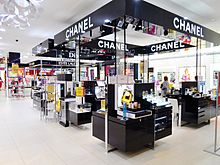
The manufacture of cosmetics is dominated by a small number of multinational corporations that originated in the early 20th century, only the distribution and sales of cosmetics is spread among a wide range of businesses. The globe'south largest corrective companies are L'Oréal, Procter & Gamble, Unilever, Shiseido, and Estée Lauder.[thirty] In 2005, the market volume of the cosmetics industry in the US, Europe, and Nihon was about EUR 70 Billion/a year.[one] In Germany, the cosmetic industry generated €12.6 billion of retail sales in 2008,[31] which makes the German cosmetic industry the third largest in the earth, later Japan and the United States. German exports of cosmetics reached €5.viii billion in 2008, whereas imports of cosmetics totaled €3 billion.[31]
The worldwide cosmetics and perfume industry currently generates an estimated almanac turnover of The states$170 billion (according to Eurostaf – May 2007). Europe is the leading marketplace, representing approximately €63 billion, while sales in France reached €6.5 billion in 2006, according to FIPAR (Fédération des Industries de la Parfumerie – the French federation for the perfume industry).[32] [ unreliable source? ] French republic is another country in which the cosmetic manufacture plays an important role, both nationally and internationally. According to data from 2008, the cosmetic industry has grown constantly in French republic for 40 sequent years. In 2006, this industrial sector reached a record level of €6.5 billion. Famous corrective brands produced in France include Vichy, Yves Saint Laurent, Yves Rocher, and many others.

The Italian cosmetic industry is likewise an important histrion in the European cosmetic market. Although not every bit large as in other European countries, the cosmetic industry in Italy was estimated to reach €ix billion in 2007.[ citation needed ] The Italian corrective industry is dominated by hair and body products and not makeup as in many other European countries. In Italian republic, pilus and body products brand upwards approximately 30% of the corrective market. Makeup and facial care are the most common corrective products exported to the United States.
Co-ordinate to Euromonitor International, the market for cosmetics in China is expected to be $seven.4 billion in 2021 up from $iv.iii billion in 2016. The increase is due to social media and the changing attitudes of people in the xviii-to-30-year historic period bracket.[33]
Due to the popularity of cosmetics, peculiarly fragrances and perfumes, many designers who are not necessarily involved in the cosmetic industry came upwards with perfumes carrying their names. Moreover, some actors and singers (such every bit Celine Dion) have their own perfume line. Designer perfumes are, like whatever other designer products, the most expensive in the manufacture as the consumer pays for the production and the brand. Famous Italian fragrances are produced by Giorgio Armani, Dolce & Gabbana, and others.
Procter & Run a risk, which sells CoverGirl and Dolce & Gabbana makeup, funded a study[34] concluding that makeup makes women seem more than competent.[35] Due to the source of funding, the quality of this Boston University study is questioned.
Cosmetics products may be retailed in beauty stores, department stores and hypermarkets, drugstores, diverseness stores, grocery stores, beauty supply stores, and many other formats, and in similar types of online stores or the online presence of these types of concrete stores.
Controversy [edit]
During the 20th century, the popularity of cosmetics increased chop-chop.[36] Cosmetics are used by girls at increasingly young ages, especially in the The states. Because of the fast-decreasing age of makeup users, many companies, from high-street brands like Rimmel to higher-end products like Estee Lauder, cater to this expanding marketplace by introducing flavored lipsticks and glosses, cosmetics packaged in glittery and sparkly packaging, and marketing and advertising using young models.[37] The social consequences of younger and younger cosmetics use has had much attending in the media over the concluding few years.
Criticism of cosmetics has come from a wide variety of sources including some feminists,[38] religious groups, animate being rights activists, authors, and public involvement groups. Information technology has also faced criticism from men, some of whom describe it as a form of deception or fakeup.[39]
Rubber [edit]
In the U.s.: "Nether the police force, cosmetic products and ingredients do not need FDA premarket approval."[40] The EU and other regulatory agencies effectually the world have more than stringent regulations.[41] The FDA does not have to approve or review cosmetics, or what goes in them, before they are sold to the consumers. The FDA just regulates against some colors that can be used in the cosmetics and pilus dyes. The cosmetic companies do not have to report any injuries from the products; they also only have voluntary recalls of products.[four]
In that location has been a marketing trend towards the sale of cosmetics defective controversial ingredients, especially those derived from petroleum, sodium lauryl sulfate (SLS), and parabens.[42] Per- and polyfluoroalkyl substances (PFAS) are a form of nigh 9,000 synthetic organofluorine compounds that have multiple highly toxic fluorine atoms attached to an alkyl chain. PFAS are used by major cosmetics industry companies in a wide range of cosmetics, including such products equally lipstick, eye liner, mascara, foundation, concealer, lip balm, blush, nail shine. A 2021 study tested 231 personal care products and found organic fluorine, a hallmark of PFAS, in more than half of the samples. Substantial levels of fluorine were identified in tested brands of products every bit follows: 82% of the brands of waterproof mascara, 63% of the brands of foundations, and 62% of liquid lipstick. PFAS compounds are readily absorbed through human skin and through tear ducts, and such products on lips are frequently unwittingly ingested. Manufacturers oft fail to label their products as containing PFAS, which makes it hard for cosmetics consumers to avoid products containing PFAS.[43]
Formaldehyde is no longer used in cosmetics just has been replaced past formaldehyde releasers. Formaldehyde is dangerous to man wellness.[44] [45] In 2011, the The states National Toxicology Program described formaldehyde as "known to be a human carcinogen".[46] [47] [48]
The danger of formaldehyde is a major reason for the development of formaldehyde releasers which release formaldehyde slowly at lower levels.[49]
Numerous reports have raised concern over the safety of a few surfactants, including 2-butoxyethanol. In some individuals, SLS may cause a number of skin problems, including dermatitis. Additionally, some individuals have had an emergence of vitiliago after using cosmetics containing the ingredient rhododendrol.[50] [51] [52] [53] [54] [55]
Parabens can cause skin irritation and contact dermatitis in individuals with paraben allergies, a small per centum of the general population.[56] Animal experiments have shown that parabens accept a weak estrogenic activity, acting as xenoestrogens.[57]
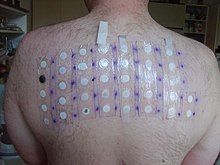
Perfumes are widely used in consumer products. Studies ended from patch testing show fragrances contain some ingredients which may cause allergic reactions.[58]
Balsam of Peru was the main recommended mark for perfume allergy before 1977, which is all the same advised. The presence of Balsam of Peru in a corrective will exist denoted by the INCI term Myroxylon pereirae.[59] [60] In some instances, Balsam of Republic of peru is listed on the ingredient label of a product by one of its diverse names, but it may not be required to be listed past its name past mandatory labeling conventions (in fragrances, for case, it may just be covered by an ingredient listing of "fragrance").[60] [61] [62] [63]
Some cosmetics companies have made pseudo-scientific claims about their products which are misleading or unsupported past scientific prove.[64] [65]
Creature testing [edit]
| | This section needs to be updated. (September 2016) |

Equally of 2019 an estimated 50-100 one thousand thousand animals are tested on each year in locations such as the U.s. and China.[66] Such tests accept involved full general toxicity, eye and peel irritants, phototoxicity (toxicity triggered by ultraviolet light), and mutagenicity.[67] [68] Due to the ethical concerns around animal testing, some nations have legislated against creature testing for cosmetics. An updated list can exist found on the Humane Societies website.[69] Co-ordinate to the Humane Society of the U.s., there are nigh 50 not-animal tests that have been validated for employ, with many more than in evolution, that may replace animal testing and are potentially more than efficacious.[70] In the United States, mice, rats, rabbits, and cats are the most used animals for testing.[71] In 2018, California banned the sale of beast tested cosmetics.[72]
Cosmetics testing is banned in the Netherlands, India, Norway, State of israel, New Zealand, Belgium, and the UK, and in 2002, the European Marriage agreed to stage in a near-full ban on the sale of animal-tested cosmetics throughout the EU from 2009, and to ban all cosmetics-related animal testing.[73] In December 2009, the European Parliament and Quango passed the EC Regulation 1223/2009 on cosmetics, a bill to regulate the cosmetic industry in the Eu.[74] EC Regulation 1223/2009 took effect on July eleven, 2013.[74] In March 2013, the Eu banned the import and sale of cosmetics containing ingredients tested on animals.[75] China required animal testing on cosmetic products until 2014, when they waived animate being testing requirements for domestically produced products.[76] In 2019, Red china approved nine non-animal testing methods, and announced that by 2020 laws making animate being testing compulsory would exist lifted.[77]
In June 2017, legislation was proposed in Australia to cease animal testing in the cosmetics manufacture.[78] In March 2019, the Australian Senate passed a bill banning the use of data from animal testing in the cosmetic industry after July ane, 2020.[79]
Legislation [edit]
Europe [edit]
In the European Wedlock, the manufacture, labelling, and supply of cosmetics and personal intendance products are regulated by Regulation EC 1223/2009.[80] It applies to all the countries of the Eu equally well as Iceland, Norway, and Switzerland. This regulation applies to single-person companies making or importing just ane product as well as to big multinationals. Manufacturers and importers of corrective products must comply with the applicable regulations in order to sell their products in the European union. In this industry, it is common fall back on a suitably qualified person, such as an independent third party inspection and testing company, to verify the cosmetics' compliance with the requirements of applicative cosmetic regulations and other relevant legislation, including Achieve, GMP, hazardous substances, etc.[81] [82]
In the European Wedlock, the circulation of cosmetic products and their condom has been a subject area of legislation since 1976. 1 of the newest improvement of the regulation apropos corrective industry is a result of the ban brute testing. Testing cosmetic products on animals has been illegal in the European Union since September 2004, and testing the split up ingredients of such products on animals is also prohibited by law, since March 2009 for some endpoints and total since 2013.[83]
Cosmetic regulations in Europe are often updated to follow the trends of innovations and new technologies while ensuring product condom. For instance, all annexes of the Regulation 1223/2009 were aimed to address potential risks to human wellness. Nether the Eu corrective regulation, manufacturers, retailers, and importers of cosmetics in Europe volition be designated every bit "Responsible Person".[84] This new status implies that the responsible person has the legal liability to ensure that the cosmetics and brands they manufacture or sell comply with the electric current corrective regulations and norms. The responsible person is too responsible of the documents contained in the Product Data File (PIF), a list of product information including information such as Cosmetic Product Safety Report, production description, GMP statement, or production function.
Us [edit]
In 1938, the U.S. passed the Nutrient, Drug, and Corrective Human action authorizing the Food and Drug Assistants (FDA) to oversee safety via legislation in the cosmetic industry and its aspects in the United States.[85] [86] The FDA joined with xiii other federal agencies in forming the Interagency Analogous Committee on the Validation of Alternative Methods (ICCVAM) in 1997, which is an attempt to ban animal testing and find other methods to test cosmetic products.[87]
The current constabulary on cosmetics in the USA do not require cosmetic products and ingredients to have FDA approval earlier going on the market place except from colour additives.[88] The Cosmetic Safe Enhancement Act was introduced in Dec 2019 by Representative Frank Pallone.[89]
Brazil [edit]
ANVISA (Agência Nacional de Vigilância Sanitária, Brazilian Health Surveillance Agency) is the regulatory torso responsible for cosmetic legislation and directives in the state. The rules use to manufacturers, importers, and retailers of cosmetics in Brazil, and most of them have been harmonized and so they tin apply to the entire Mercosur.
The current legislation restricts the use of certain substances such every bit pyrogallol, formaldehyde, or paraformaldehyde and bans the apply of others such as lead acetate in cosmetic products. All restricted and forbidden substances and products are listed in the regulation RDC 16/11 and RDC 162, 09/eleven/01.
More recently, a new cosmetic Technical Regulation (RDC 15/2013) was set upwards to establish a list of authorized and restricted substances for cosmetic use, used in products such as hair dyes, nail hardeners, or used as product preservatives.
Most Brazilian regulations are optimized, harmonized, or adjusted in social club to exist applicable and extended to the entire Mercosur economical zone.
International [edit]
The International Organisation for Standardization (ISO) published new guidelines on the rubber manufacturing of cosmetic products nether a Practiced Manufacturing Practices (GMP) regime. Regulators in several countries and regions have adopted this standard, ISO 22716:2007, effectively replacing existing guidance and standards. ISO 22716 provides a comprehensive approach for a quality direction system for those engaged in the manufacturing, packaging, testing, storage, and transportation of cosmetic end products. The standard deals with all aspects of the supply concatenation, from the early commitment of raw materials and components until the shipment of the final product to the consumer.
The standard is based on other quality management systems, ensuring smooth integration with such systems as ISO 9001 or the British Retail Consortium (BRC) standard for consumer products. Therefore, it combines the benefits of GMP, linking corrective production safety with overall business improvement tools that enable organisations to run across global consumer demand for corrective product condom certification.[90]
In July 2012, since microbial contamination is i of the greatest concerns regarding the quality of cosmetic products, the ISO has introduced a new standard for evaluating the antimicrobial protection of a cosmetic product past preservation efficacy testing and microbiological risk assessment.
Encounter as well [edit]
- Airbrush makeup
- Makeup brush
- Baking
- Body art
- Contouring
- Cosmeceutical
- Cosmetic packaging
- Electrotherapy (corrective)
- Female cosmetic coalitions
- Henna
- Ingredients of cosmetics
- Male cosmetics
- Moulage
- Natural skin care
- Palm oil
- Permanent makeup
- Peel care
References [edit]
- ^ a b c d e Schneider, Günther; Gohla, Sven; Schreiber, Jörg; Kaden, Waltraud; Schönrock, Uwe; Schmidt-Lewerkühne, Hartmut; Kuschel, Annegret; Petsitis, Xenia; Pape, Wolfgang (2001). Skin Cosmetics. Ullmann'southward Encyclopedia of Industrial Chemistry. John Wiley & Sons, Ltd. doi:x.1002/14356007.a24_219. ISBN978-3-527-30673-two. OCLC 910197915. Archived from the original on 21 February 2022. Retrieved 2022-02-21 .
- ^ Liddell, Henry George and Scott, Robert. κοσμητικός Archived 2020-08-03 at the Wayback Motorcar in A Greek-English Lexicon
- ^ Liddell, Henry George and Scott, Robert. κόσμος Archived 2020-eleven-01 at the Wayback Machine in A Greek-English Lexicon
- ^ a b c d due east f grand h i "Cosmetics and Your Health – FAQs". Womenshealth.gov. November 2004. Archived from the original on 2013-03-12.
{{cite spider web}}: CS1 maint: bot: original URL status unknown (link) - ^ "Cosmetics Overview". U.Southward. Food & Drug Administration. Archived from the original on 30 March 2019. Retrieved 30 March 2019.
- ^ Angeloglou, Maggie. The History of Make-up. Starting time ed. Great U.k.: The Macmillan Visitor, 1970. 41–42. Impress.
- ^ Pallingston, J (1998). Lipstick: A Celebration of the World's Favorite Corrective. St. Martin's Press. ISBN978-0-312-19914-2.
- ^ Dow, Bonnie J. (Spring 2003). "Feminism, Miss America, and Media Mythology". Rhetoric & Public Affairs. 6 (1): 127–149. doi:10.1353/rap.2003.0028. S2CID 143094250.
- ^ Duffett, Judith (Oct 1968). WLM vs. Miss America. Voice of the Women'southward Liberation Motion. p. 4.
- ^ Due north, Anna (24 September 2018). "What the rise of men's makeup means for masculinity". Vox . Retrieved 10 April 2022.
- ^ Elan, Priya (23 Feb 2020). "Beauty and the gars: why more men are wearing makeup". the Guardian . Retrieved 10 April 2022.
- ^ "Eyebrow Pencil". Cosmetics Info. Archived from the original on 2013-08-06. Retrieved 2021-08-24 .
- ^ Riordan, Teresa (2004-12-12). "'Inventing Beauty'". The New York Times. ISSN 0362-4331. Archived from the original on 2021-08-24. Retrieved 2021-08-24 .
- ^ McDearmon, Christa. The Eyelash Extension Professional person Training Manual: Teacher's Guide. Charleston, SC: CreateSpace Independent Publishing Platform, 2014.
- ^ a b "Soaps and cleansers | DermNet NZ". www.dermnetnz.org. Archived from the original on 2021-04-11. Retrieved 2021-03-31 .
- ^ Sarkar, Rashmi; Arora, Pooja; Garg, K Vijay (2013). "Cosmeceuticals for Hyperpigmentation: What is Available?". Journal of Cutaneous and Artful Surgery. 6 (ane): 4–11. doi:x.4103/0974-2077.110089. ISSN 0974-2077. PMC3663177. PMID 23723597.
- ^ a b "British Association of Dermatologists - Sunscreen Fact Sheet". www.bad.org.united kingdom. Archived from the original on 2021-04-xi. Retrieved 2021-03-31 .
- ^ a b c "British Clan of Dermatologists - Sunscreen Fact Sheet". www.bad.org.britain. Archived from the original on 2021-04-11. Retrieved 2021-04-06 .
- ^ "Hair and Beauty Manufacture Statistics". National Hair & Beauty Federation. Archived from the original on 2021-04-11. Retrieved 2021-03-31 .
- ^ "Shampoos". Medscape. Archived from the original on 2021-05-02. Retrieved 2021-03-31 .
- ^ a b "Fragrances and perfumes | DermNet NZ". www.dermnetnz.org. Archived from the original on 2021-04-eleven. Retrieved 2021-03-31 .
- ^ Webster, Emma Sarran. "This Is the Real Difference Between Natural and Synthetic Makeup Brushes". Teen Vogue. Archived from the original on 2018-05-07. Retrieved 2018-05-07 .
- ^ Singer, Natasha (2007-11-01). "Natural, Organic Beauty". The New York Times. Archived from the original on 2017-07-01. Retrieved 2017-02-21 .
- ^ Reshetnikov SV, Wasser SP, Duckman I, Tsukor K (2000). "Medicinal value of the genus Tremella Pers. (Heterobasidiomycetes) (review)". International Periodical of Medicinal Mushrooms. two (iii): 345–67. doi:10.1615/IntJMedMushr.v2.i3.10.
- ^ "The Lowdown on Mineral Makeup". WebMD. p. 2. Archived from the original on 16 Nov 2018. Retrieved 29 October 2018.
- ^ Administration, Australian Government Department of Health. Therapeutic Appurtenances (2017-01-11). "Literature review on the safe of titanium dioxide and zinc oxide nanoparticles in sunscreens". Therapeutic Goods Administration (TGA). Archived from the original on 2018-07-17. Retrieved 2018-07-17 .
- ^ Anderson, Heather. "Ten Benefits of Mineral Makeup (and Why You Should Make Your Own)". Archived from the original on 2019-05-05. Retrieved 2019-05-05 .
- ^ "Agreement the Cosmetics Regulation". Cosmetics Europe Association. Archived from the original on 4 November 2016. Retrieved iii November 2016.
- ^ International Organisation for Standardization. "ISO 22715:2006 Cosmetics – Packaging and labelling". ISO.org. Archived from the original on 4 November 2016. Retrieved ii November 2016.
- ^ Top 100 Cosmetic Manufacturers. scribd.com
- ^ a b "Corrective Industry". Archived from the original on 2010-09-08. Retrieved 2010-08-04 .
- ^ "France continues to atomic number 82 the mode in cosmetics". ClickPress. 24 July 2008. Archived from the original on two May 2021. Retrieved 21 February 2022.
- ^ Wei, Daniela (2017-05-31). "Bloggers Touting Makeup Secrets Spur Estee Lauder'southward People's republic of china Sales". Bloomberg News. Archived from the original on 2017-06-01. Retrieved 2017-06-02 .
- ^ Etcoff, Due north. L.; Stock, S; Haley, L. E.; Vickery, S. A.; House, D. One thousand. (2011). "Cosmetics as a Feature of the Extended Man Phenotype: Modulation of the Perception of Biologically Important Facial Signals". PLOS ONE. 6 (10): e25656. Bibcode:2011PLoSO...625656E. doi:10.1371/journal.pone.0025656. PMC3185017. PMID 21991328.
- ^ "Makeup Makes Women Appear More Competent: Study". The New York Times. 2011-ten-12. Archived from the original on 2017-04-17. Retrieved 2017-02-21 .
- ^ Millikan, Larry E. (2001). "Cosmetology, cosmetics, cosmeceuticals: Definitions and regulations". Clinics in Dermatology. 19 (4): 371–4. CiteSeerX10.1.1.467.6719. doi:x.1016/S0738-081X(01)00195-X. PMID 11535376.
- ^ Vocaliser, Natasha (March 26, 2011). "What would Estee Do?". The New York Times. Archived from the original on 7 May 2013. Retrieved 18 March 2014.
- ^ Battista, Kathy (2012-09-19). "Cindy Hinant'due south make-up, glamour and TV prove". Phaidon. Archived from the original on 2021-ten-26. Retrieved 2022-02-21 .
The American feminist artist's [Cindy Hinant] get-go solo show at Manhattan's Joe Sheftel Gallery plays with feminine ethics and expectations, as well as before artistic movements, says Dr Kathy Battista of Sotheby's Institute of Art, New York...A series of MakeUp Paintings appear as pale monochromatic works, simply closer inspection reveals they are the result of the artist'south daily action of blotting her face on the paper. The variation in tones calls attention to the use of makeup as artifice and the layered structure of the female self.
- ^ Franks, Mary Anne. "How to Feel similar a Adult female, or Why Punishment is a Elevate." UCLA L. Rev. 61 (2013): 566.
- ^ "FDA Authority Over Cosmetics". fda.gov. 8 March 2021. Archived from the original on 22 Apr 2019. Retrieved 16 December 2019.
- ^ "EUR-Lex – co0013 – EN – EUR-Lex". europa.eu. Archived from the original on 2015-05-08. Retrieved 2022-02-21 .
- ^ "Signers of the Compact for Safe Cosmetics". Campaign for Safe Cosmetics. Archived from the original on 2007-06-09. Retrieved 2007-07-05 .
- ^ The Guardian (UK), 15 June 2021, "Toxic 'Forever Chemicals' Widespread in Meridian Makeup Brands, Study Finds--Researchers Observe Signs of PFAS in over Half of 231 Samples of Products Including Lipstick, Mascara and Foundation" Archived 2021-06-26 at the Wayback Machine
- ^ "Formaldehyde", Formaldehyde, 2-Butoxyethanol and 1-tert-Butoxypropan-ii-ol (PDF), IARC Monographs on the Evaluation of Carcinogenic Risks to Humans 88, Lyon, France: International Bureau for Research on Cancer, 2006, pp. 39–325, ISBN978-92-832-1288-one, archived (PDF) from the original on 2017-12-15, retrieved 2022-02-21
- ^ "Formaldehyde (gas)", Study on Carcinogens, Eleventh Edition Archived 2019-08-06 at the Wayback Machine (PDF), U.S. Department of Health and Human Services, Public Health Service, National Toxicology Program, 2005
- ^ Harris, Gardiner (2011-06-10). "Authorities Says 2 Common Materials Pose Risk of Cancer". The New York Times. Archived from the original on 2019-03-28. Retrieved 2011-06-eleven .
- ^ National Toxicology Program (2011-06-10). "12th Report on Carcinogens". National Toxicology Program. Archived from the original on 2011-06-08. Retrieved 2011-06-11 .
- ^ National Toxicology Program (2011-06-10). "Study On Carcinogens – 12th Edition – 2011" (PDF). National Toxicology Program. Archived from the original on 2011-06-12. Retrieved 2011-06-11 .
- ^ de Groot Ac, van Joost T, Bos JD, van der Meeren HL, Weyland JW (1988). "Patch exam reactivity to DMDM hydantoin. Relationship to formaldehyde allergy". Contact Dermatitis. 18 (4): 197–201. doi:10.1111/j.1600-0536.1988.tb02802.ten. PMID 3378426.
- ^ Bilensoy, Erem (2011). Cyclodextrins in Pharmaceutics, Cosmetics, and Biomedicine : Electric current and Future Industrial Applications. John Wiley & Sons, Incorporated. ISBN978-0-470-92680-2.
- ^ Agner T (1991). "Susceptibility of atopic dermatitis patients to irritant dermatitis caused by sodium lauryl sulphate". Acta Derm. Venereol. 71 (4): 296–300. PMID 1681644.
- ^ Nassif A, Chan SC, Storrs FJ, Hanifin JM (November 1994). "Abnormal peel irritancy in atopic dermatitis and in atopy without dermatitis". Arch Dermatol. 130 (xi): 1402–7. doi:ten.1001/archderm.130.11.1402. PMID 7979441.
- ^ Marrakchi Southward, Maibach Hi (2006). "Sodium lauryl sulfate-induced irritation in the man face: regional and age-related differences". Skin Pharmacol Physiol. 19 (three): 177–80. doi:10.1159/000093112. PMID 16679819. S2CID 35890797.
- ^ "7: Last Study on the Prophylactic Assessment of Sodium Lauryl Sulfate and Ammonium Lauryl Sulfate". International Journal of Toxicology. 2 (seven): 127–181. 1983. doi:x.3109/10915818309142005. S2CID 34123578.
- ^ Löffler H, Effendy I (May 1999). "Skin susceptibility of atopic individuals". Contact Derm. forty (5): 239–42. doi:10.1111/j.1600-0536.1999.tb06056.x. PMID 10344477. S2CID 10409476.
- ^ Nagel JE, Fuscaldo JT, Fire-eater P (April 1977). "Paraben allergy". JAMA. 237 (15): 1594–5. doi:10.1001/jama.237.xv.1594. PMID 576658.
- ^ Byford JR, Shaw LE, Drew MG, Pope GS, Sauer MJ, Darbre PD (Jan 2002). "Oestrogenic action of parabens in MCF7 human breast cancer cells". J. Steroid Biochem. Mol. Biol. 80 (i): 49–60. doi:10.1016/S0960-0760(01)00174-1. PMID 11867263. S2CID 6667945.
- ^ Frosch PJ, Pilz B, Andersen KE, et al. (November 1995). "Patch testing with fragrances: results of a multi-center written report of the European Environmental and Contact Dermatitis Research Group with 48 oft used constituents of perfumes". Contact Derm. 33 (5): 333–42. doi:10.1111/j.1600-0536.1995.tb02048.x. PMID 8565489. S2CID 44355890.
- ^ Beck, M. H.; Wilkinson, S. M. (2010), "26. Contact Dermatitis: Allergic", Rook's Textbook of Dermatology, vol. 2 (8th ed.), Wiley, p. 26.40, doi:ten.1002/9781444317633.ch26, ISBN978-1-4443-1763-iii
- ^ a b Johansen, Jeanne Duus; Frosch, Peter J.; Lepoittevin, Jean-Pierre (2010). Contact Dermatitis. Springer. ISBN978-3-642-03827-iii. Archived from the original on August five, 2020. Retrieved March 13, 2014.
- ^ Fisher, Alexander A. (2008). Fisher's Contact Dermatitis. PMPH-United states of america. ISBN978-one-55009-378-0. Archived from the original on 2020-08-05. Retrieved 2015-eleven-06 .
- ^ William D. James; Timothy Berger; Dirk Elston (2011). Andrew'due south Diseases of the Skin: Clinical Dermatology. Elsevier Wellness Sciences. ISBN978-1-4377-3619-9. Archived from the original on 2018-05-17. Retrieved 2015-11-06 .
- ^ Zhai, Hongbo; Maibach, Howard I. (2004). Dermatotoxicology (Sixth ed.). CRC Press. ISBN978-0-203-42627-two. Archived from the original on Baronial 5, 2020. Retrieved March 13, 2014.
- ^ McLaughlin, Martyn (2007-12-xx). "Pseudo science can't encompass up the ugly truth". The Scotsman. Edinburgh. Archived from the original on 2009-04-04. Retrieved 2009-12-16 .
- ^ "Cosmetics". Badscience.net. Archived from the original on 2011-ten-xi. Retrieved 2011-x-23 .
- ^ Kabene, Stefane; Baadel, Said (2019-11-12). "Bioethics: a look at animate being testing in medicine and cosmetics in the UK". Periodical of Medical Ethics and History of Medicine. 12: fifteen. doi:10.18502/jmehm.v12i15.1875. ISSN 2008-0387. PMC7166243. PMID 32328228.
- ^ Watson, Stephanie (2009). Beast Testing: Issues and Ethics. New York : The Rosen Publishing Grouping. ISBN978-ane-4358-5671-iv.
- ^ Ferdowsian, Hope R.; Beck, Nancy (2011). "Ethical and Scientific Considerations Regarding Animal Testing and Inquiry". PLOS ONE. 6 (nine): e24059. Bibcode:2011PLoSO...624059F. doi:10.1371/periodical.pone.0024059. PMC3168484. PMID 21915280.
- ^ "Timeline: Cosmetics testing on animals". The Humane Society of the U.s.a.. Archived from the original on 2021-01-21. Retrieved 2021-02-05 .
- ^ "Fact Sail: Cosmetic Testing : The Humane Order of the Usa". world wide web.humanesociety.org. Archived from the original on 2022-02-21. Retrieved 2018-05-01 .
- ^ "Animal Testing 101". 22 June 2010. Archived from the original on vi May 2019. Retrieved 5 May 2019.
- ^ Hanson, Hilary (2018-09-29). "California Simply Officially Banned The Sale Of Fauna-Tested Cosmetics". Huffington Post. Archived from the original on 2019-05-17. Retrieved 2019-05-17 .
- ^ "Ban on Beast Testing – Growth – European Commission". Growth. 2016-07-05. Archived from the original on 2018-ten-26. Retrieved 2018-x-26 .
- ^ a b "Regulation (EC) No 1223/2009 of the European Parliament and of the Quango". 22 December 2009. Archived from the original on 13 May 2019. Retrieved 17 May 2019.
- ^ Kanter, James (2013-03-11). "Eastward.U. Bans Cosmetics With Animal-Tested Ingredients". The New York Times. ISSN 0362-4331. Archived from the original on 2019-05-09. Retrieved 2019-05-17 .
- ^ "Here'south How Prc Is Moving Abroad From Animal Testing". www.bloomberg.com. 16 January 2018. Archived from the original on 2019-05-17. Retrieved 2019-05-13 .
- ^ Morosini, Daniela (10 Apr 2019). "Communist china Will No Longer Crave Animal Testing On Cosmetic Products". British Vogue. Archived from the original on 2019-05-13. Retrieved 2019-05-13 .
- ^ "Australia'due south animal testing laws are a good showtime, simply don't make it plenty". phys.org. Archived from the original on 2019-05-17. Retrieved 2019-05-17 .
- ^ Jacobs, Steve (2019-03-16). "Commonwealth of australia bans employ of data from animal tests in cosmetics". The Sydney Morning Herald. Archived from the original on 2019-05-17. Retrieved 2019-05-17 .
- ^ "EUR-Lex – 32009R1223 – EN – EUR-Lex". europa.eu. Archived from the original on 2021-05-01. Retrieved 2022-02-21 .
- ^ "Production safety for manufacturers". bis.gov.uk. Archived from the original on 2012-eleven-05. Retrieved 2022-02-21 .
- ^ "The Single Marketplace". cosmeticseurope. Archived from the original on 2021-06-05. Retrieved 2021-07-01 .
- ^ "Regulatory context". ec.europa.eu. Archived from the original on 2010-07-xx. Retrieved 2010-08-04 .
- ^ "EU Cosmetic Regulation 1223/2009" Archived 2019-05-thirteen at the Wayback Machine, European Parliament & Council, 30 Nov 2009, Retrieved 7 April 2015
- ^ "Federal Food, Drug, and Cosmetic Human activity (FD&C Human activity)". fda.gov. Archived from the original on 2017-03-18. Retrieved 2019-12-16 .
- ^ "The 1938 Food, Drug, and Cosmetic Act". Nutrient and Drug Assistants. Archived from the original on 2 May 2015. Retrieved 22 April 2015.
- ^ "Beast Testing & Cosmetics". Food and Drug Assistants. Archived from the original on 11 February 2017. Retrieved x February 2017.
- ^ Nutrition, Center for Nutrient Prophylactic and Applied (iv February 2020). "FDA Dominance Over Cosmetics: How Cosmetics Are Not FDA-Approved, but Are FDA-Regulated". FDA. Archived from the original on 22 April 2019. Retrieved xix August 2020.
- ^ "Why your cosmetics don't have to be tested for safety". PBS. xvi December 2019. Archived from the original on two October 2020. Retrieved 19 August 2020.
- ^ ISO 22716 Archived 2016-10-04 at the Wayback Machine ISO Guidelines on Good Manufacturing Practices, Retrieved 09/27/2012
Further reading [edit]
- Wintertime, Ruth (2005) [2005]. A Consumer's Dictionary of Cosmetic Ingredients: Complete Data About the Harmful and Desirable Ingredients in Cosmetics (Paperback). US: 3 Rivers Press. ISBN978-i-4000-5233-two.
Source: https://en.wikipedia.org/wiki/Cosmetics
Posted by: perezthavall.blogspot.com
0 Response to "What Percentage Of Makeup Is Tested On Animals"
Post a Comment