

A Full-sized Drawing Made As A Guide For A Work In Another Medium Is A
Watercolor is a medium that can be as demanding and temperamental as those who choose to paint with it. But it is a colorful and exciting medium all the same – well suited to describing the many moods of the subject, as well as those of the artist wielding the brush.
–Jean Burman

Do your kids like to paint? Have you had success with watercolors? Traditional dry paint palettes of color are what most of us purchase for first watercolor experiments, but my go-to supply, and one of my favorite kid art supplies period, isliquid watercolor.
Watercolors are one of my favorite mediums to paint with, and somehow I forgot about that. I became an acrylic painter in high school, and then an oil painter after college. But the immediacy of watercolors — the flowing of colors from one into another and their quick-drying quality — makes it so appealing to the parent of young children who are equally quick and impatient.
I don't have days to wait for paint to dry and I don't have to worry myself over toxic paint stinking up my house. But watercolors are perfect and my kids adore them too.
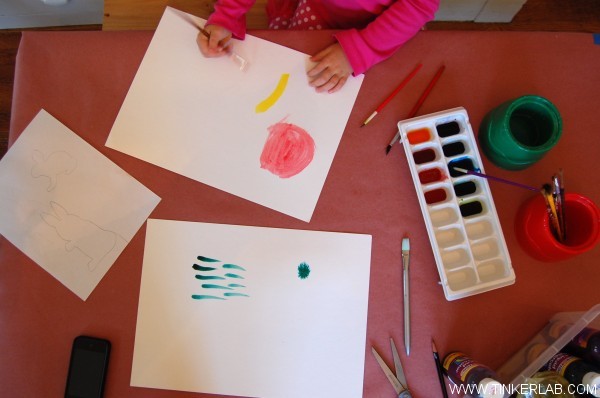 To set this up, I removed the usual plastic sheet that protects our art table and replaced it with red rosin paper. Red Rosin Paperis heavy sheathing paper usually used as a first step to cover new roofs, and you can find it in hardware stores. It comes on a huge roll, it's economical, and it was perfect for absorbing the watercolor paint that didn't make it onto the art paper.
Materials
- Table cover
- Watercolor Paper. This paper from Seth Cole is what we used. It's 140 lb. (it's thick and heavy = good), professional grade, acid-free, archival, and economical.
- Liquid Watercolors. We like Sax Concentrated Liquid Watercolors from Amazon.
- Assorted small paintbrushes (sable or synthetic fibers)
- Container for watercolors — I like to use an ice cube tray. A styrofoam egg carton also works well.
- Water cups or cans
- Cloth or Paper towels
We filled our ice cube tray with every color we own (except black). I avoided black because if it's not used with discretion it quickly muddles up all the colors. We talked aboutwarm and cool colors, and divided our colors into these two camps: on one side there was red, orange, yellow, and sparkly red. The other side held lime green, turquoise, blue, sparkly blue, and violet.
Set up your towels next to the paint and brushes and use them to absorb extra water or paint of the brush.
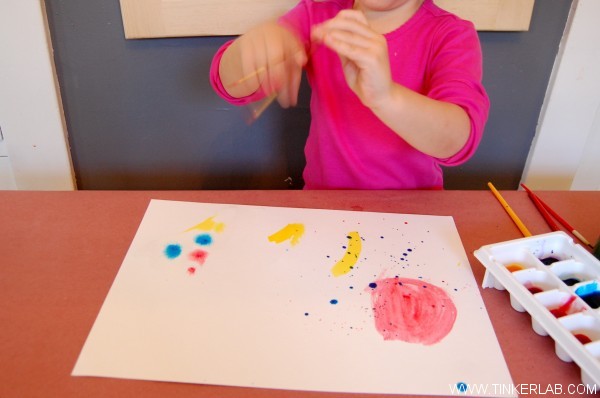
I like to paint across from or next to my daughter because I find that her own ideas expand when she sees me work through my ideas. I never paint on her painting, but I may test some ideas out on my own paper that can help her come up with her own solutions.
We explored two kinds of watercolor painting: wet on dry and wet on wet. Wet on dry is the process of painting on dry paper. And wet on wet is the process of painting on wet paper. She painted a little wet on dry, and then I demonstrated wet on wet for her. She's done this before, but seeing it again got her excited and she wanted to see the colors expand on her paper. You can see the wet on wet blue dots on the left side of her paper.
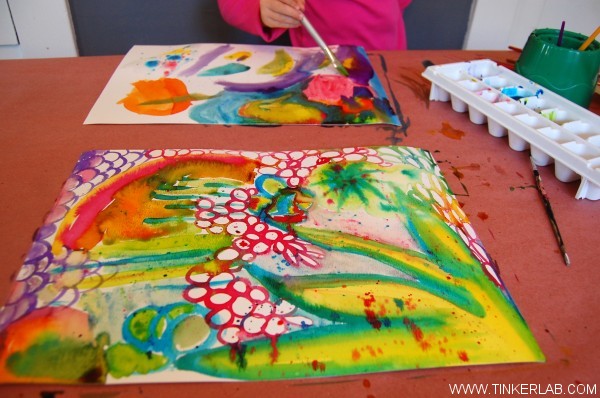
I also experimented with tapping the side of my wet, paint-loaded brush to create dots of paint all over my page, and she did the same. She loved this, actually, and thought it was hilarious when the paint splattered her face. Good lesson in paint control!
If you're new to watercolor painting, it helps to talk with your child about gently dragging a loaded (full) brush against the edge of the paint container before painting. This helps keep paint puddles to a minimum and also teaches your child how to control the amount of paint that goes onto the paper. I wouldn't worry about this too much with really young children, but be three or four, your child should be able to grasp this concept.
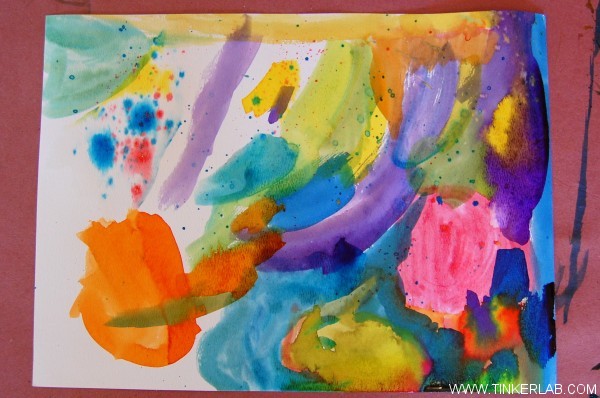 All along, her plan was to make a bunny garland to hang in our window, so we let the paintings dry and I made bunny template that she was happy with.
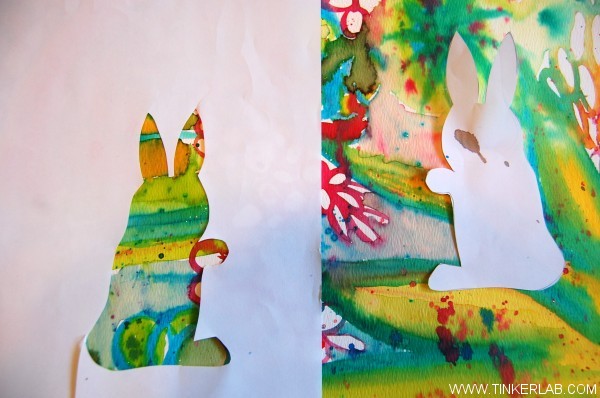 We placed it over the paper to see how it might look. Love it!
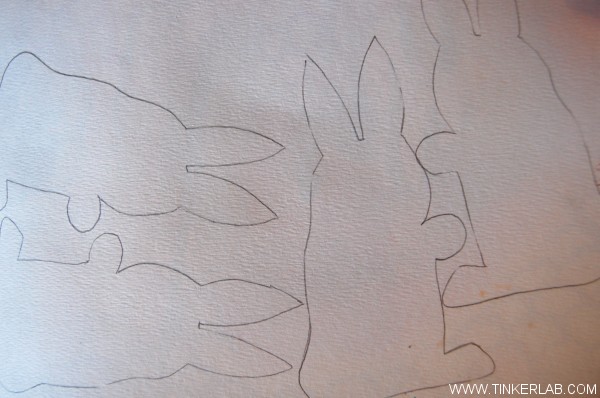 And then I traced them on the back of the paper. The hardest part of this process was cutting the bunnies out. Not hard, exactly, but just to warn you, this step took a fair amount of time.
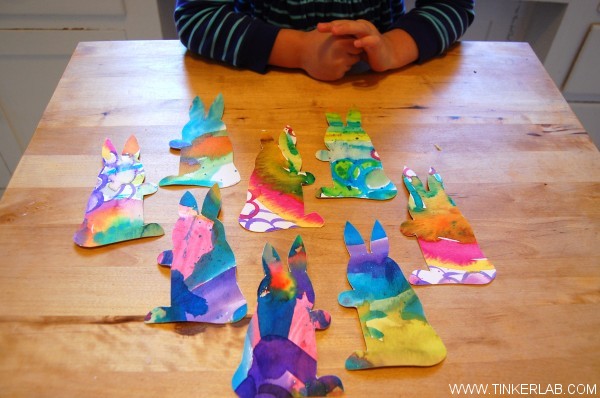 And there's our first batch of bunnies, waiting to be strung up in the window.
I'm not sure exactly how we'll hang them. Any ideas for us? I was thinking about gluing baker's twine to the backs, but I'd like them to be somewhat archival so that we can use them year after year.
*************************
If you enjoy watercolor painting, you'll want to bookmarkSpiral Watercolor Streamer, Straw-blown Watercolor Painting,and Candle Wax Watercolor Resistand you will want to check out The Artful Parent's great list of11 Fun Watercolor Projects for Kids.
A Full-sized Drawing Made As A Guide For A Work In Another Medium Is A
Source: https://tinkerlab.com/how-to-watercolor-bunnies-with-kids/
Posted by: perezthavall.blogspot.com
0 Response to "A Full-sized Drawing Made As A Guide For A Work In Another Medium Is A"
Post a Comment